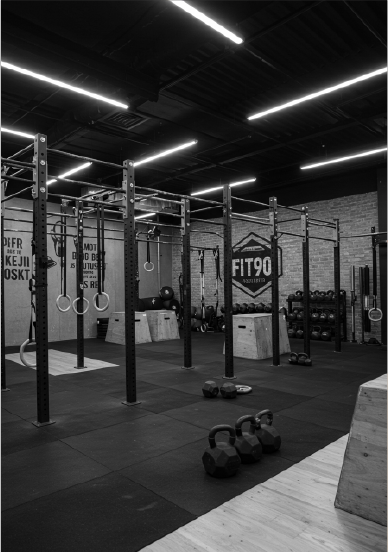


The hardest workout of your first ninety days is the one where you walk through the door.
Most people don’t quit because the training is too hard. They quit before starting, because they don’t know what’s about to happen and they’d rather not find out in front of a room full of people who clearly already know.
So here’s the whole thing, before you commit to any of it.
Before you arrive
Message us. Tell us two things: what you’re training for, and how many days a week you can genuinely show up — the real number, not the ambitious one.
That’s it. No form, no assessment questionnaire, no call.
What to bring
Trainers, a change of clothes, a towel, and a water bottle. That’s the entire list. You don’t need gloves, a belt, straps, or anything you saw on Instagram. If you end up needing them, you’ll know months from now, and a coach will tell you.
The first fifteen minutes
You’ll be met by a coach, not a salesperson.
They’ll ask about injuries, previous training, what your job does to your body all day, and what you’re actually here for. Answer honestly — including the parts that sound like excuses. “I sit for nine hours and my back hurts” is more useful to a coach than any goal you could name.
Then a short movement check. Nothing intimidating: a few basic patterns, bodyweight, so the coach can see how you move before deciding what you’re allowed to load. This is the part that keeps you training in month three instead of nursing something.
The session itself
You train on day one. You don’t get a tour and a price sheet.
If you’re joining a class, the coach knows you’re new before you walk in, and every movement gets scaled to you. Scaling isn’t a lesser version of the workout — it’s the same session at the intensity that’s actually productive for your body today.
If you’re on the floor, you leave with a written plan, not a vague suggestion to “start with machines”.
Two things that won’t happen: nobody watches you, and nobody trains alone on their first day. The first is true because everyone in that room is occupied with their own set. The second is a rule.
Afterwards
A coach walks you through what you did and why, and what the next session looks like. You’ll be sore in a day or two — that’s normal and it fades fast once you’re consistent.
Then a conversation about membership, and only then. We’ll ask what you’re training for and how often you can commit, and recommend the option that fits — including telling you when the cheaper one is the right one.
The bit people worry about most
Nobody is looking at you.
The person you assume is judging your weight selection is counting their own reps and thinking about their own set. Everyone in that room started somewhere, most of them recently, and most of them remember the day they walked in.
Show up once. The rest is logistics.